Brotkrümelnavigation:
Main content:
Futures Literacy

FuturesComp
A Catalyst for Futures Literacy-Oriented Higher Education in Austria
How can we prepare students for a turbulent, complex and uncertain future? This question is becoming increasingly important in the context of social, technological and environmental transformations – and this is precisely where the FuturesComp comes in. With the FuturesComp, Austria now has, for the first time, a comprehensive, practice-oriented framework that supports higher education institutions in systematically embedding future-oriented thinking and futures literacy into teaching, curricula and institutional development. The FuturesComp was developed on behalf of the Federal Ministry for Women, Science and Research. Under the leadership of the UNESCO Chair in Futures Capability for Innovation and Entrepreneurship at MCI | The Entrepreneurial School®, the UNESCO Chair in Learning and Teaching Futures Literacy in the Anthropocene at the University College of Teacher Education Lower Austria contributed its expertise in teacher education and higher education didactics. Together, they have created a forward-looking framework for the future of higher education in Austria.
Futures Literacy: Understanding the Future as a Space of Possibilities
At the heart of this lies the concept of futures literacy – the ability to understand the changes brought about by the current era of transformation, to address them in a solution-oriented manner, to imagine different futures, and to build a future worth living in for everyone in the present. The future is not understood here as a predetermined course of events, but as an open space of possibilities that opens up different perspectives and courses of action across multiple futures – desirable, plausible, dystopian; in short: POLY-futures. Futures literacy thus encompasses the ability to anticipate change and to develop concrete, responsible options for shaping the future.
The FuturesComp structures futures literacy along five central dimensions:
- Exploration of POLY-futures – perceiving and understanding possible futures
- Co-responsibility for POLY-futures – reflecting on ethical and societal responsibility
- Shaping POLY-futures – actively working towards desirable futures
- Self-development within POLY-futures – developing personal attitudes and capabilities
- Participation in POLY-futures – collaboratively shaping the future
These competencies highlight a crucial point: futures education is not only about thinking about the future, but about actively shaping it and taking responsibility.
From Vision to Implementation
The framework provides concrete support for higher education practice, including defined learning objectives and learning outcomes, didactic guidelines and next-practice examples for innovative teaching. Its development is grounded in a robust scientific foundation, including systematic literature reviews, expert interviews, and international focus group workshops.
Beyond teaching, FuturesComp also serves as a normative and conceptual guide for curriculum development and institutional transformation.
The FuturesComp extends beyond the classroom and has broader educational and societal relevance. It demonstrates how higher education institutions can empower students not only to analyse the future, but to shape it actively, reflectively, and responsibly.
“Promoting Futures Literacy is a key component of future-oriented higher education. FuturesComp provides valuable guidance and encourages the development of innovative teaching and learning formats.”
— Eva-Maria Holzleitner, Federal Minister for Women, Science and Research
“This FuturesComp opens up, enables, and advances the future orientation of higher education demanded by society—for universities, universities of applied sciences, and teacher education institutions alike.”
— Edda Polz, Vice-Rector, University College of Teacher Education Lower Austria
“The FuturesComp gives higher education didactics a significant boost: creating images of the future establishes relevance to learners’ lifeworlds—across disciplines and in transdisciplinary ways.”
— Carmen Sippl, UNESCO Chair
“Futures Literacy is more than a competence—it is a societal resource. It strengthens exactly those capacities we need for cohesion, innovation, and transformation.”
— Antje Bierwisch, UNESCO Chair at MCI
Learning to Shape the Future
With the FuturesComp, MCI and the University College of Teacher Education Lower Austria are making a significant contribution to the further development of higher education in Austria. The goal is clear: students should not only be prepared for future challenges—they should be empowered to actively, reflectively, and responsibly shape societal developments.
Because the future is not something that simply happens—it is created through our actions in the present.
Edited Volume on Futures Literacy
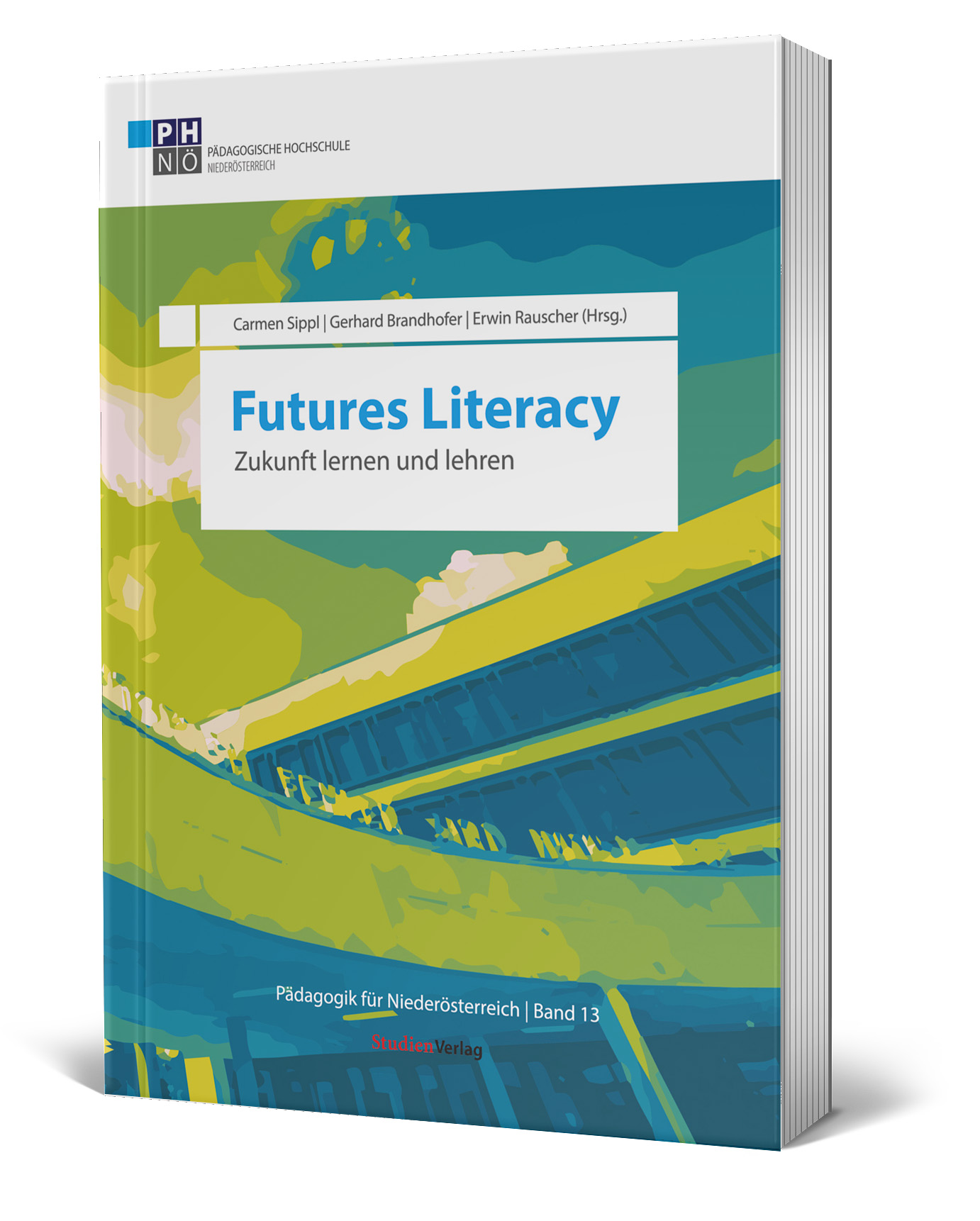
Futures Literacy
Zukunft lernen und lehren
Edited by Carmen Sippl, Gerhard Brandhofer & Erwin Rauscher
Innsbruck et al.: Studienverlag
(Pädagogik für Niederösterreich, vol. 13)
ISBN 978-3-7065-6263-8
DOI: https://doi.org/10.53349/oa.2022.a2.170
UNESCO has declared Futures Literacy as an essential competence for the 21st century. Each individual should be empowered to develop strategies for coping with an uncertain future in the face of climate change. Futures Literacy encompasses the anticipation and imagination of alternative futures, the acceptance of complexity and a new understanding of our capacities to act, in order to develop concrete ideas, positive images and creative solutions with responsibility.
What exactly is this: competence in shaping the future? What educational content focuses on the challenges facing society? How can the digital disruptions be used for transformation? What creative, cultural, artistic practices open up ecological awareness? Which model and exemplary implementations can be designed in the school at the present time? Which didactic concepts anchor Futures Literacy in teacher training?
Thinking – telling – shaping the future: The interdisciplinary contributions in this anthology not only show the broad spectrum of aspects that are bundled in the concept of Futures Literacy. They also make it clear how futures education can succeed in concrete educational processes.