Brotkrümelnavigation:
Main content:
Dissemination
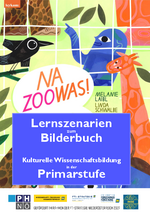
Teaching Resources for Cultural Science Education
“Refreshing and bold colour combinations meet a playful visual language. This is perfectly complemented by concise factual information about the ‘creatures’ and their relationship with ‘humans’.” This is how the jury of the 2026 Austrian Children’s and Young People’s Book Prize justified the award, which was presented on 20 May 2026 to Melanie Laibl and Linda Schwalbe, the author and illustrator of the picture book NA ZOOWAS! Just in time for the award ceremony, an educational resource has been published, created by students training to be primary school teachers at the University College of Teacher Education Lower Austria during the 2025/26 academic year. The focus is on science education from a cultural studies perspective. To this end, the combination of an ‘extremely turbulent history of the zoo’ (from the jury’s statement) and an ‘Extra for the Curious’ at the end of the story proves to be a groundbreaking pairing: It invites readers not only to explore the animals from a zoological perspective, but also to critically examine human-animal relationships from an ethical standpoint and to explore the zoo as a culturally shaped landscape as well as a research centre for species conservation. The theme of freedom can be addressed in philosophical discussions with children when exploring animal rights and human rights, thereby contributing to democracy education. Free DOWNLOAD
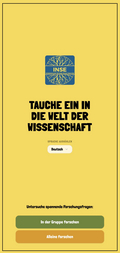
Science App – Experiencing Scientific Thinking
The Science App is an interactive learning tool for teenagers that demonstrates how scientific research works. Based on five real-world research questions, learners are guided step by step through the full scientific inquiry process. For each question, students select hypotheses, design experiments, and draw conclusions. In doing so, they learn what makes a good hypothesis, how to plan meaningful experiments, and how to interpret results correctly. With direct feedback, sample graphs, and clear help texts, the app conveys scientific thinking in an accessible and practical way. Access App
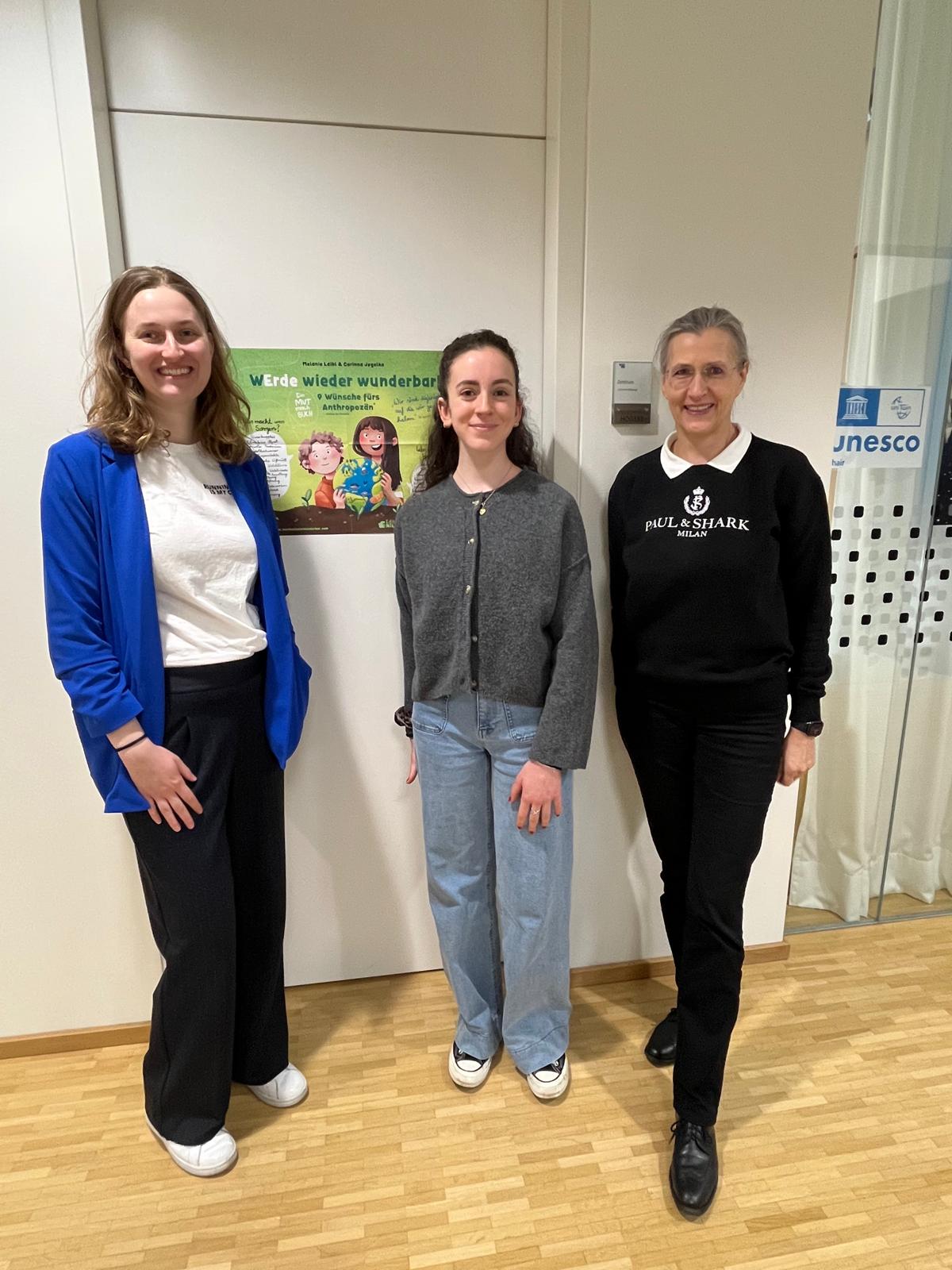
New intern at the Center Futures Literacy and the UNESCO Chair for Learning and Teaching Futures Literacy in the Anthropocene
The UNESCO Chair and the Center Futures Literacy are pleased to welcome our new intern, Morgane Cretin-Reina, from École normale supérieure Paris-Saclay in Paris! With a focus on graphic design and expertise in science communication, she will support ongoing projects, especially INSE, the Network for Science education. Her focus is particularly on the graphic presentation of scientific content in order to convey complex topics in an understandable and appealing way.
We are looking forward to the collaboration and exciting exchanges!
The day is finally here! The SCIBORG game is live!
What is SCIBORG?
SCIBORG is a board game designed to promote scientific literacy and critical thinking. It is aimed at both teenagers and adults, and playfully conveys key concepts of the research process. Players take on the roles of researchers and navigate through the various phases of the research process. The goal is to achieve scientific breakthroughs through strategic decisions and a little bit of luck.
How can I play SCIBORG?
The game is available in a “print and play” format and online.
DOWNLOAD SCIBORG game materials and see our “how-to-play” video here: www.science-education.at/projects/project-sciborg/
Or, you can PLAY ONLINE on Tabletopia here: tabletopia.com/games/sciborg
Want to know more?
Follow us on Instagram (@sciborgproject) or Facebook (www.facebook.com/sciborgproject) to stay up-to-date on SCIBORG.
If you have any questions, comments, or feedback, please feel free to contact Dr. Laura E. Coulson at WasserCluster Lunz under laura.coulson(at)wcl.ac.at.